How to Track Isometrics: The Complete Truth About Static Training
Learn the science behind isometric training, when to use it, and how to track it effectively. Understand why isotonics are usually better for most lifters.
How to Track Isometrics: The Complete Truth About Static Training
Let's be clear upfront: for most lifters, isotonic exercises (regular dynamic movements) are superior to isometrics. However, isometric training has specific applications where it excels - particularly for time-efficiency and injury management. This guide will explain the science, practical applications, and tracking methods for isometric training.
The Critical Difference: Isotonic vs Isometric Contractions
Before diving into tracking methods, you need to understand why isometric training is fundamentally different - and often less effective - than traditional training.
Isotonic Contractions (Regular Training)
Isotonic means "same tension" - though in practice, tension varies throughout the range of motion. These are your standard exercises:
- Concentric phase: Muscle shortens (lifting the weight up)
- Eccentric phase: Muscle lengthens (lowering the weight down)
- Full range of motion: Stimulates muscle at multiple lengths
- Clear progression markers: Weight, reps, and sets are easily tracked
- High motivation: You can see and feel the weight moving
Isometric Contractions (Static Training)
Isometric means "same length" - the muscle contracts without changing length:
- No movement: Joint angle remains fixed
- Single position training: Strength gains are angle-specific (±15-20°)
- Difficult to track: No reps to count, weight often irrelevant
- Lower motivation: Hard to gauge progress or effort objectively
The Science: Why Isometrics Can Build Muscle (But Usually Don't)
The Length-Tension Relationship
When an isometric contraction is performed at a muscle length that optimizes the length-tension relationship, you can generate extremely high degrees of mechanical tension - one of the key drivers of hypertrophy.
Here's what happens during a properly executed max-effort isometric:
- Maximum mechanical tension: Up to 20% more force than concentric contractions
- Complete motor unit recruitment: Similar to the last 5 reps before failure in isotonic training
- Involuntary force production: Your nervous system is forced to recruit all available muscle fibers
This sounds great in theory. The problem? Most people can't generate true maximum effort without external feedback.
The Motivation Problem: Why Isometrics Fail
The biggest limitation of isometric training isn't physiological - it's psychological:
- No objective feedback: You can't see if you're pushing at 70% or 100% effort
- Perception of effort varies: What feels like max effort might only be 80%
- No progressive overload visibility: Can't add 5 pounds like with regular training
- Reduced motor unit recruitment: Lower motivation = lower actual force output
Research on visual feedback suggests that seeing a number (like a dynamometer reading) helps people push harder on maximal efforts. Without numbers to chase, you may be leaving force on the table.
The Burst Method: How to Actually Do Isometrics Effectively
If you're going to do isometrics, here's the evidence-based approach that actually works:
Duration Requirements
To match the stimulus of 4-6 effective reps in an isotonic set, you need 12-16 seconds of maximum effort isometric contractions. But here's the critical part:
Never sustain a max contraction for 12-16 seconds straight.
Why? Force production starts to drop within a few seconds of a maximal contraction as metabolites accumulate:
Metabolic Fatigue Cascade:
- Inorganic phosphate accumulation: Builds up as phosphocreatine is broken down, reducing the force each cross-bridge produces and impairing calcium release
- Hydrogen ion accumulation: Lowers muscle pH, reducing contractile protein function
- Calcium handling impairment: Sarcoplasmic reticulum can't maintain calcium release
- CNS fatigue: Central drive declines, reducing motor unit recruitment
This metabolite buildup is the primary reason sustained isometric holds become ineffective. After 4-5 seconds of maximum effort, you're no longer generating maximum force - you're just fighting through metabolic stress. This defeats the entire purpose of isometric training, which depends on maximum force production and maximum effort to create:
- High degrees of mechanical tension
- High motor unit recruitment
- Optimal hypertrophic stimulus
Without max force = no max effort = reduced motor unit recruitment = suboptimal training stimulus.
The Burst Protocol
Instead, break those 12-16 seconds into bursts:
- Burst duration: 3-4 seconds of TRUE maximum effort
- Rest between bursts: 2-3 seconds (not 1 second - CNS needs time)
- Total bursts: 4-5 bursts per "set"
- Total time under tension: 12-20 seconds accumulated
Example set structure:
- 4 seconds max effort
- 3 seconds rest
- 4 seconds max effort
- 3 seconds rest
- 4 seconds max effort
- 3 seconds rest
- 4 seconds max effort
- = 16 seconds total time under tension
CNS Fatigue Reality Check
You cannot do maximum effort isometrics for multiple exercises in one session.
After 2-3 sets of true maximum effort isometrics, you can expect:
- Noticeably lower force in the exercises that follow
- Fatigue that may need extra recovery before your next hard session
- Reduced motor unit recruitment capacity
This limits how much quality volume an isometric-only program can deliver.
Setting Up Maximally Stable Isometric Exercises
For isometrics to work, you need absolutely stable positions. Any energy spent on stabilization reduces force production.
Key Setup Principles
- Maximum contact points: More contact with stable surfaces = more force
- Optimal joint angles: Use positions where you're naturally strongest
- External resistance: Push/pull against immovable objects, not air
When Isometrics Actually Make Sense
Despite their limitations, isometrics excel in specific scenarios:
1. Time Efficiency
- Short sessions: A few minutes of hard isometric work can provide a meaningful strength stimulus
- No loading/unloading weights
- No rest between reps (just between sets)
- Ideal for minimal equipment
2. Injury Management
- Joint-friendly: No impact or movement-related stress
- Specific angle training: Avoid painful ranges of motion
- Tendon loading: Isometrics are one useful way to load tendons, alongside slow, heavy dynamic work
- Return-to-sport bridge: Build strength before returning to dynamic movement
Caution: Maximum-effort isometrics raise blood pressure sharply, especially if you hold your breath. Keep breathing through each effort instead of bracing with a held breath (the Valsalva maneuver), and get clearance from a doctor or physiotherapist before using them for rehab, around an injury, or if you have high blood pressure or another cardiovascular condition.
3. Sticking Point Training
- Strength curve specific: Target exact angles where you're weak
- Overload capability: Use more weight than you could move dynamically
- Neural adaptations: Improve motor unit recruitment at specific positions
4. End-Range Strength
- Injury prevention: Strengthen positions where injuries occur
- Flexibility with strength: Build strength in stretched positions
- Sport-specific positions: Hold positions relevant to your sport
The Harsh Reality of Tracking Isometrics
Without specialized equipment, tracking isometric progress is tricky. Here's what you're up against:
The Tracking Challenge
Why Time-Based Tracking Fails:
The fundamental problem is that time held does not equal force produced. Here's what's actually happening during a "16-second hold":
Seconds 1-4: Close to true maximum effort Seconds 5-8: Fighting metabolic fatigue (force declining) Seconds 9-12: Fighting metabolic fatigue (force still declining) Seconds 13-16: Closer to an endurance effort than a strength effort
So when you track "improved from 16s to 17s," you might actually be getting:
- Same maximum force phase (4 seconds each time)
- Better fatigue tolerance (longer low-force endurance)
- Zero improvement in strength (the part that matters for hypertrophy)
This is why metabolite buildup makes progressive overload tracking nearly impossible without force measurement. You're conflating strength gains with metabolic conditioning improvements.
Manual Tracking Methods (Limited Effectiveness)
If you must track isometrics manually, here's the best approach:
Progressive Overload Without Equipment
Since you can't reliably track force, manipulate these variables:
- Increase time (least reliable)
- Add external load (for yielding isometrics only)
- Change leverage (move to harder positions)
- Increase frequency (more sessions per week)
Advanced Tracking: The Dynamometer Solution
If you're serious about isometric training, you need objective measurement. This is where dynamometers come in.
What Dynamometers Actually Measure
Unlike guessing with RPE, dynamometers provide:
- Peak force: Maximum force achieved
- Average force: Sustained force throughout contraction
- Rate of force development: How quickly you reach peak force
- Force decline: Fatigue during sustained holds
The Motivation Multiplier
Research on visual feedback suggests that seeing your force output in real time can bring:
- Higher force output on maximal efforts
- Better consistency between sets
- Improved long-term adherence
- Actual progressive overload tracking
Practical Dynamometer Use
For Serious Athletes/Coaches
Professional Options ($500-3000):
- VALD DynaMo series for comprehensive testing
- Provides app integration and progress tracking
- Worth it if training multiple athletes
Mid-Range Options ($200-500):
- Basic handheld dynamometers
- Good for personal use
- Limited features but accurate readings
For Testing Only (Not Daily Training)
Many physical therapy clinics and sports performance centers offer dynamometer testing. Consider:
- Monthly max force testing
- Establish baseline and track trends
- Use results to adjust training
Sample Dynamometer Protocol
Exercise: Isometric Mid-Thigh Pull Target: 3 x 5-second maximum efforts
Set 1: Peak 245kg, Avg 218kg Rest 3 minutes Set 2: Peak 251kg, Avg 223kg Rest 3 minutes Set 3: Peak 242kg, Avg 215kg
Notes: 9kg peak (8kg average) drop-off from set 2 to 3 indicates fatigue Next session: Reduce to 2 working sets
Programming Reality: How to Actually Use Isometrics
For Most Lifters: Supplementary Only
Primary training: 80-90% isotonic exercises Isometric work: 10-20% as assistance
Common Programming Mistakes
- Too many exercises: 5 max-effort isometric exercises are likely too much
- Daily training: Max-effort isometrics need recovery time between sessions
- Long sustained holds: Force drops off within a few seconds of a max effort
- No objective measurement: Guessing at effort = leaving gains behind
Technology and Apps: What Actually Helps
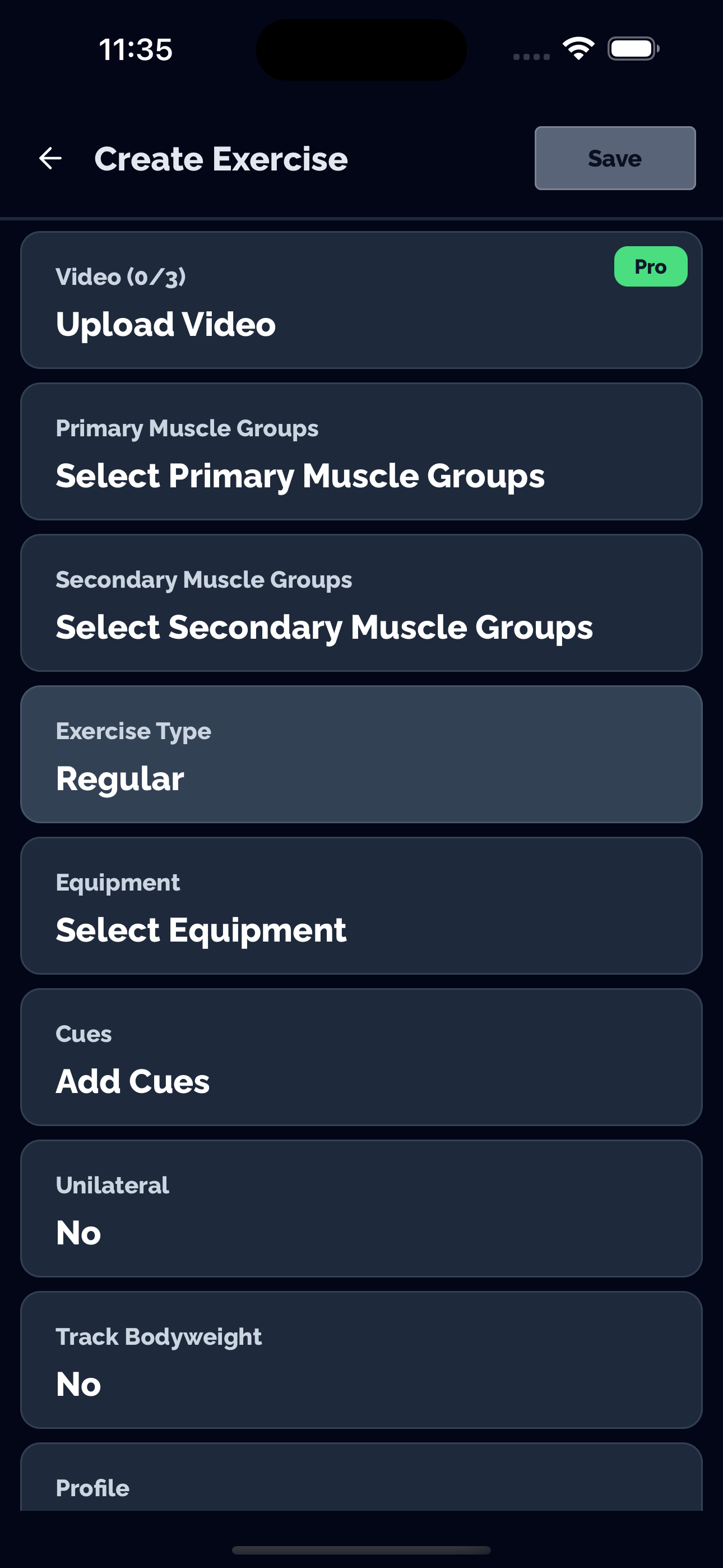
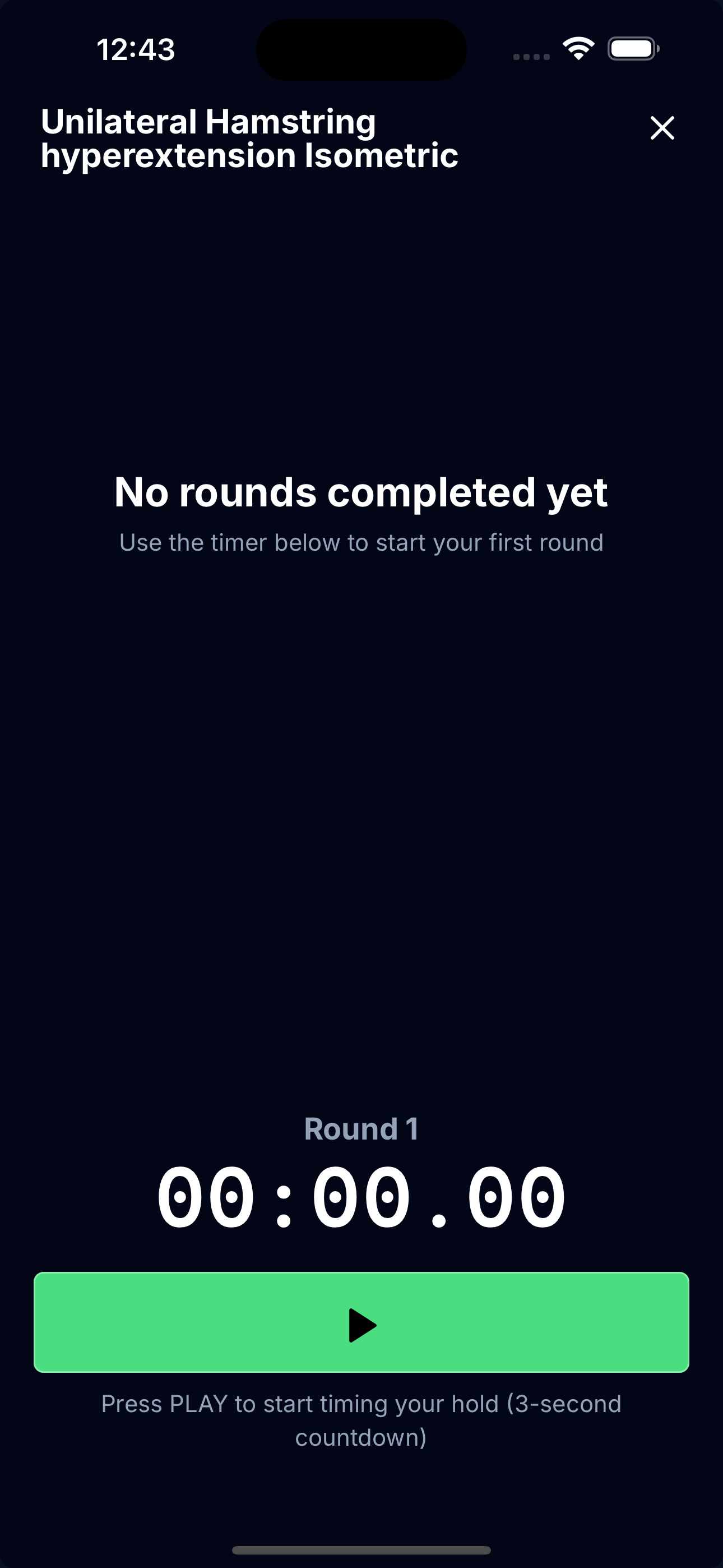
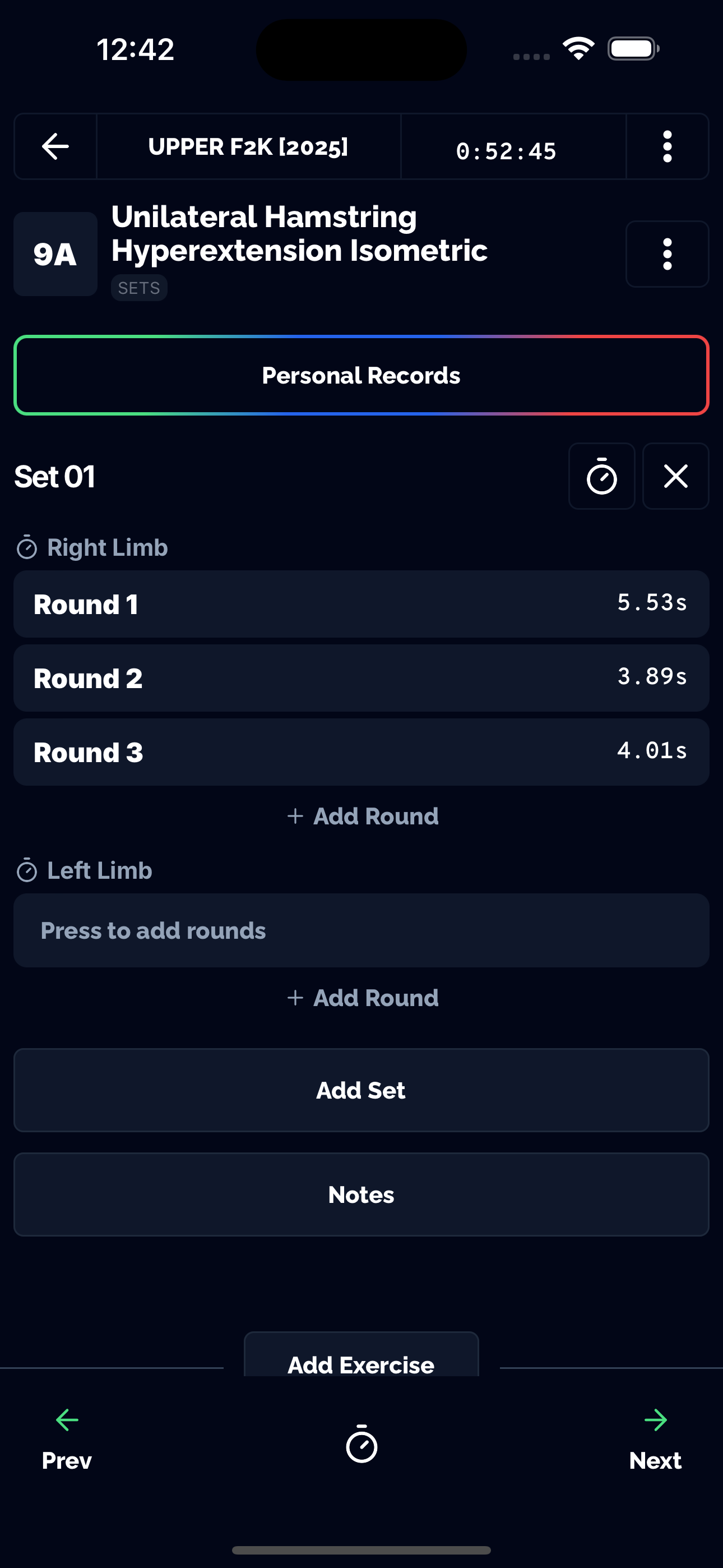
Tracked has a dedicated isometric set type built into its programs, so you can log hold duration and load right alongside your regular sets — with both weight and time-based progressive overload. The app helps you systematically track your isometric training progress, making it easier to maintain motivation and ensure consistent advancement - even when using a dynamometer for force measurement. Isometric holds count toward your personal records too, so a longer max-effort hold shows up the same way a heavier lift would. This combination of subjective tracking and objective measurement provides the most complete picture of your isometric training progress.
Useful Technology
Timer apps with audio cues:
- Set 4-second work, 3-second rest intervals
- Audio coaching maintains rhythm
- Removes counting distraction
Force measurement apps (requires compatible hardware):
- Real-time force feedback
- Progress tracking over time
- Motivation through numbers
Not Useful
Generic fitness apps: Most can't properly program isometric bursts Heart rate tracking: Doesn't correlate with force production Movement tracking apps: There's no movement to track
The Bottom Line: When to Track Isometrics
Track Isometrics When:
- You have a dynamometer or access to force measurement
- Recovering from injury and can't do dynamic movements
- Targeting specific sticking points in your lifts
- Time is extremely limited (traveling, 10-minute workouts)
- Joint pain prevents isotonic training
If you're using isometrics for injury rehab or around joint pain, get clearance from a clinician first, and don't hold your breath during max efforts: they raise blood pressure, so take extra care with any cardiovascular condition.
Skip Isometric Tracking When:
- You're a beginner - master isotonic basics first
- You want maximum hypertrophy - isotonics are superior
- You lack motivation for self-directed max efforts
- You're already doing high-volume isotonic training
- You don't have objective measurement tools
Conclusion: The Isometric Reality
Isometric training can be effective, but it faces significant practical limitations. The inability to track progressive overload, combined with motivation challenges, makes it inferior to isotonic training for most goals.
However, when used strategically - particularly with objective force measurement - isometrics become valuable tools for:
- Time-efficient training
- Injury rehabilitation
- Specific strength development
- Tendon health
The key is understanding that isometrics are a tool, not a complete training system. Use them when they solve specific problems, but don't expect them to replace the proven effectiveness of traditional dynamic training.
Remember: If you can't measure it, you can't manage it. And with isometrics, measurement is everything.